

About the Client
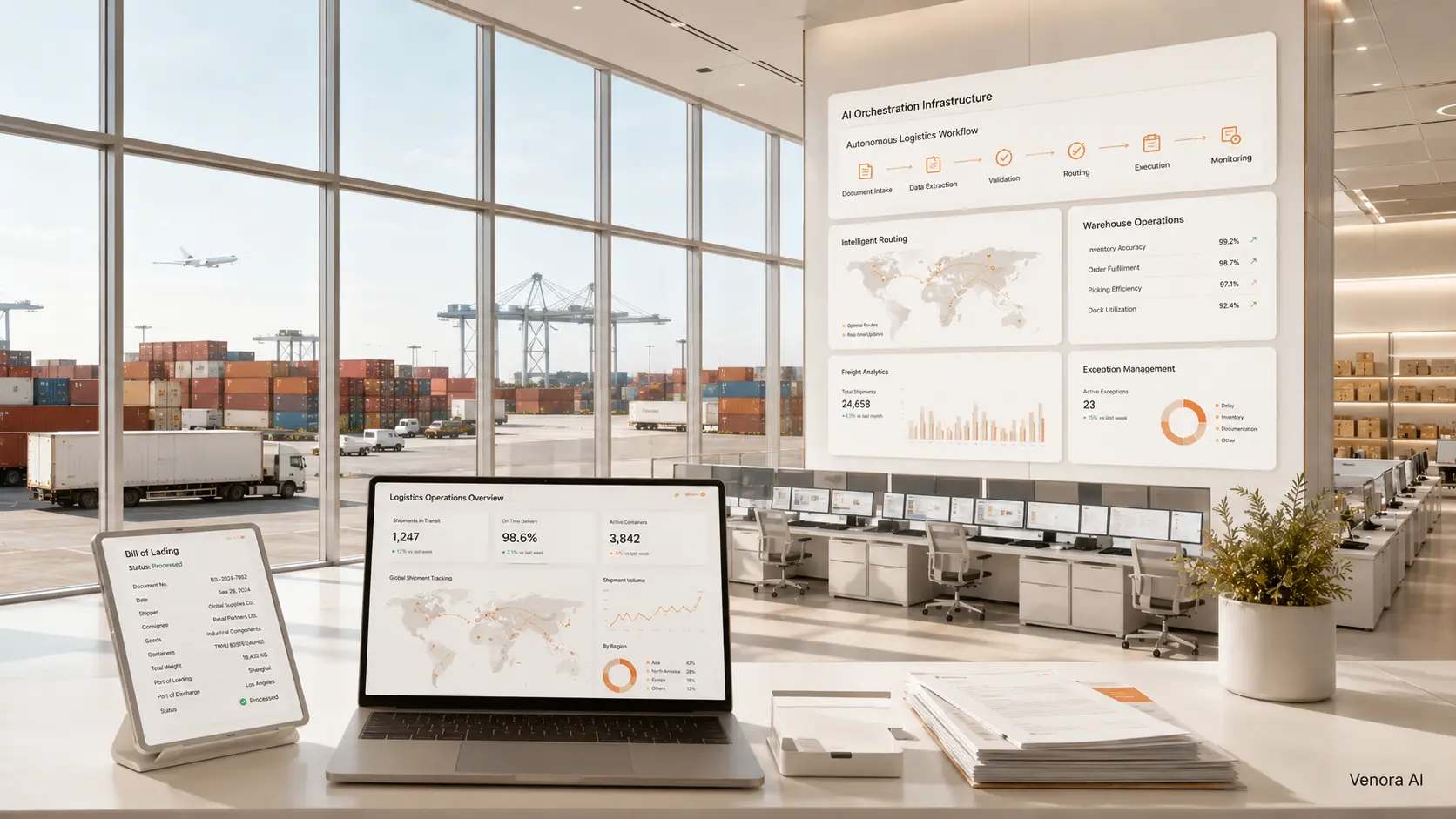
A national enterprise logistics provider manages thousands of international freight shipments every day. Every shipment generates invoices, customs declarations, warehouse manifests, compliance documents, bills of lading, and supplier paperwork.
Before partnering with Venora AI, nearly every document was reviewed manually by operations teams across multiple departments.
Although the organization had already digitized its documents, the actual decision-making process still depended heavily on manual validation, resulting in slow turnaround times and increasing operational costs.
Business Challenge

The client faced several operational challenges simultaneously.
Manual Validation
Each logistics partner generated documents using completely different layouts and formatting standards.
No two invoices looked alike.
Employees were required to manually compare information across multiple files before approving shipments.
Slow Processing
Document processing frequently exceeded 12 hours, delaying shipment releases and creating downstream bottlenecks throughout the supply chain.
Limited Scalability
During seasonal demand spikes, the company relied on hiring temporary operational staff simply to keep up with document volume.
This increased costs while introducing additional human error.
Accuracy Issues
Human operators frequently encountered:
- Incorrect customs values
- Missing invoice information
- Duplicate shipment records
- Compliance mismatches
- Manual typing mistakes
These errors resulted in shipment delays and financial penalties.
Venora AI Solution
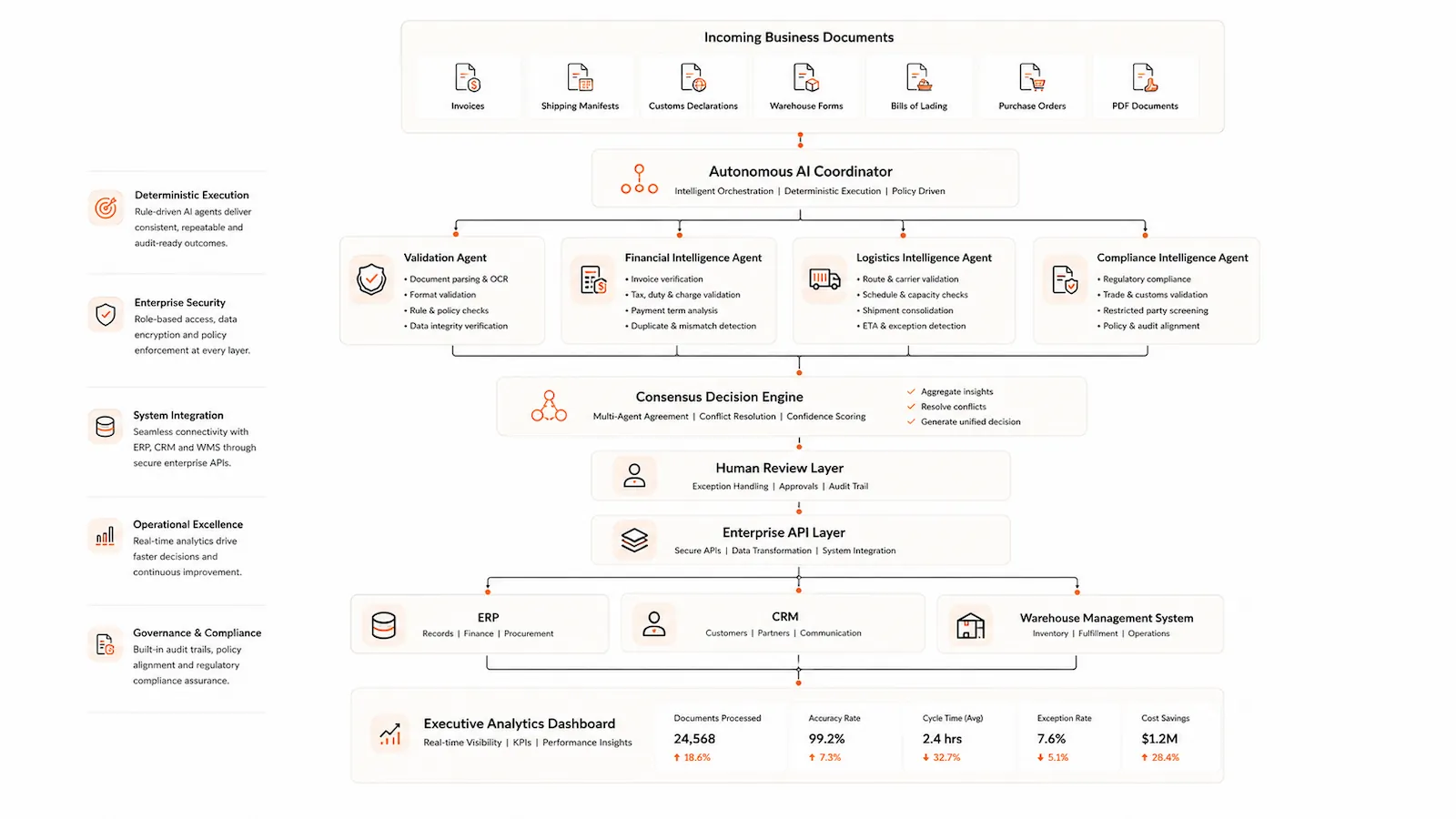
Rather than deploying a traditional chatbot, Venora AI designed a deterministic enterprise AI workflow composed of specialized autonomous agents.
Each agent performs one highly specific responsibility before passing validated information to the next stage.
The system behaves like an intelligent production pipeline instead of a conversational assistant.
Architecture
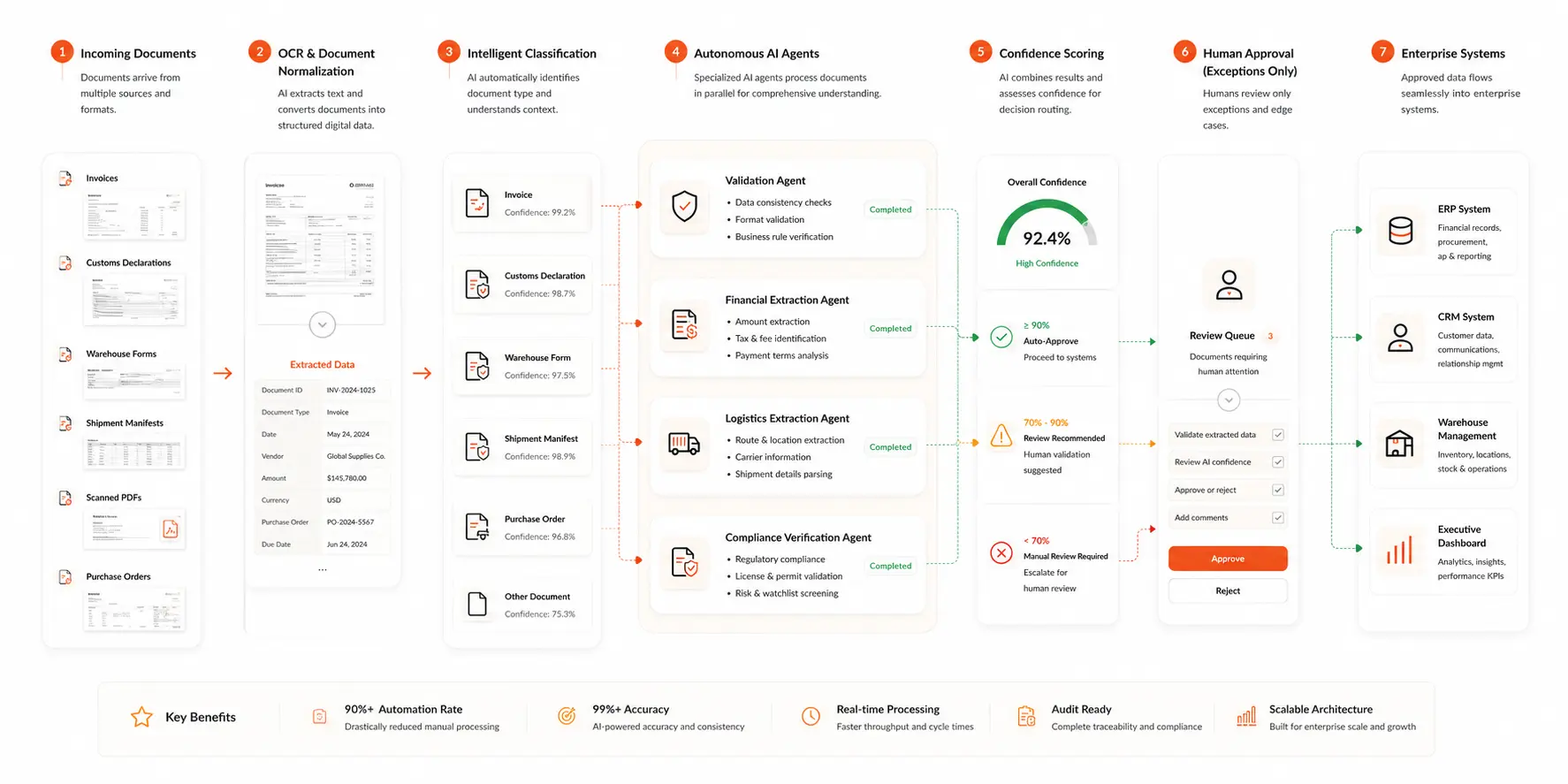
The workflow consists of five specialized AI agents.
1. Document Validation Agent
The first agent receives every incoming document.
Responsibilities include:
- OCR cleanup
- Image enhancement
- Duplicate detection
- File classification
- Format normalization
2. Information Extraction Agents
Three independent extraction agents process documents simultaneously.
Each specializes in a different business domain.
Financial Agent
Extracts:
- Invoice values
- Currency
- Taxes
- Payment terms
Logistics Agent
Extracts:
- Shipment IDs
- Warehouse locations
- Container numbers
- Delivery schedules
Compliance Agent
Extracts:
- Customs information
- Regulatory declarations
- Country-specific compliance data
Running these agents in parallel reduced overall execution time dramatically.
3. Consensus Engine
Instead of trusting a single AI response, outputs from all extraction agents are compared using a consensus engine.
When confidence exceeds predefined thresholds, the system automatically approves the document.
If confidence is low, the document is routed to a human reviewer.
This Human-in-the-Loop workflow provides enterprise-grade reliability.
4. Workflow Automation
Validated information automatically updates:
- ERP
- Warehouse Management System
- Internal CRM
- Shipment Dashboard
No manual data entry is required.
Technology Stack
The platform was built using enterprise-ready technologies.
- Python
- LangGraph
- FastAPI
- OpenAI o1
- PostgreSQL
- Redis
- Docker
The architecture was designed for horizontal scaling, allowing additional AI agents to be introduced without changing existing workflows.
Business Results
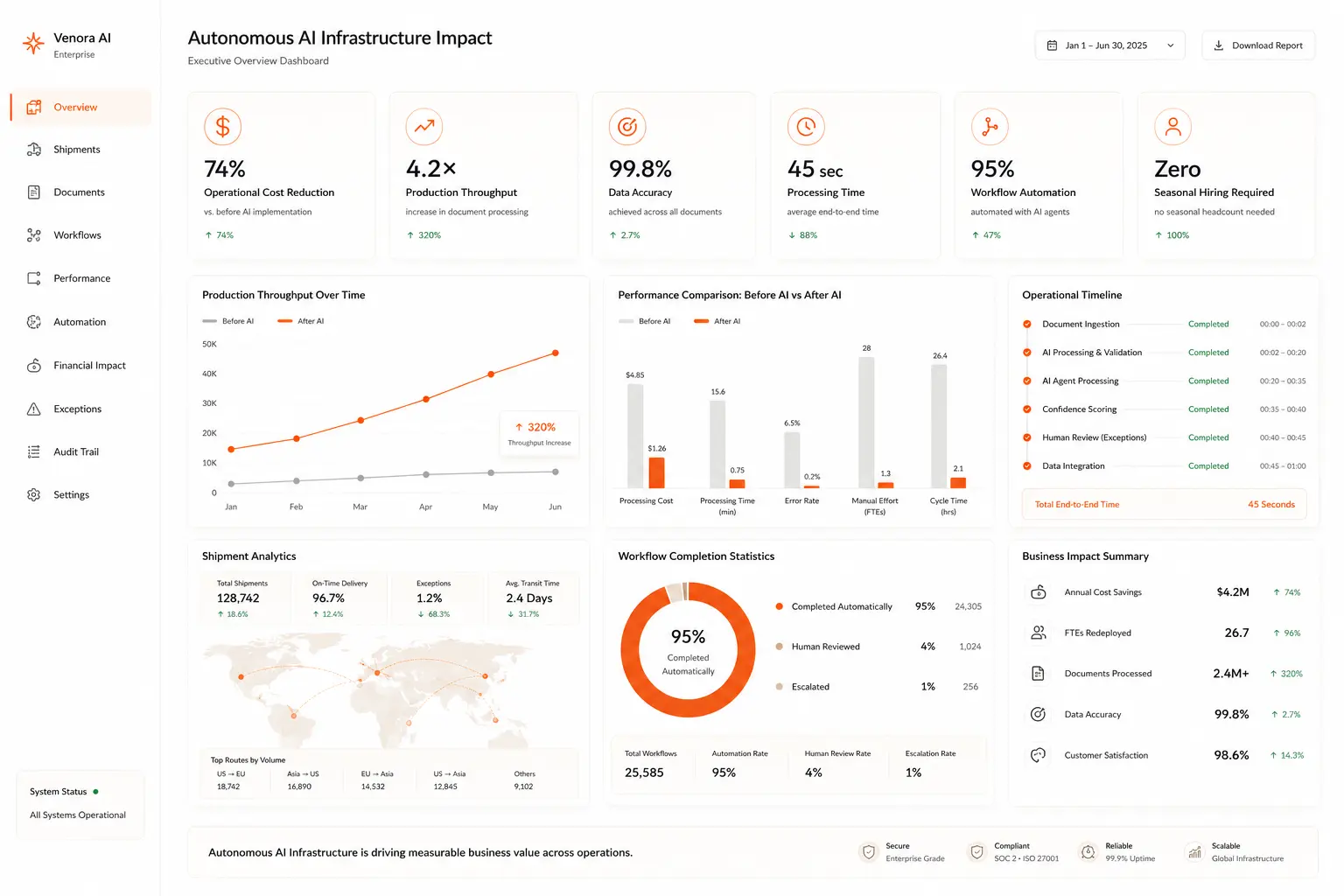
Within six months of deployment, the client experienced significant operational improvements.
Operational Cost
Reduced by 74%
Processing Time
Reduced from 12 hours to 45 seconds
Throughput
Increased by 4.2×
Accuracy
Improved to 99.8%
Automation
Over 95% of all documents now complete processing without human intervention.
Why the System Worked
The project's success was driven by architectural decisions rather than model size.
Key design principles included:
- Deterministic AI workflows
- Specialized AI agents
- Parallel execution
- Confidence scoring
- Human approval for edge cases
- Enterprise integration
- Continuous monitoring
This produced predictable, auditable, and highly scalable automation suitable for enterprise operations.
Client Feedback
"Venora AI completely transformed the way our operations team works. We no longer think about document processing as a staffing problem. The AI infrastructure handles the majority of the workload automatically while our specialists focus only on complex exceptions. It has become one of the highest ROI technology investments our organization has ever made."
Jonathan Vance
Director of Operations
Key Outcomes
- 74% lower operational costs
- 4.2× higher processing throughput
- 99.8% document accuracy
- 95% workflow automation
- 45-second average processing time
- Zero additional staffing required during peak seasons
Looking to Build Something Similar?
Venora AI designs enterprise-grade AI systems that automate business operations using intelligent agents, workflow orchestration, retrieval-augmented generation (RAG), and custom software engineering.
Whether you're building AI agents, automating enterprise workflows, or modernizing legacy operations, our team can design a scalable AI architecture tailored to your business.
Need something similar?
Let's build your next AI system.
Whether you're exploring AI agents, workflow automation, enterprise search, RAG, or custom software, we'll help design the right solution.