

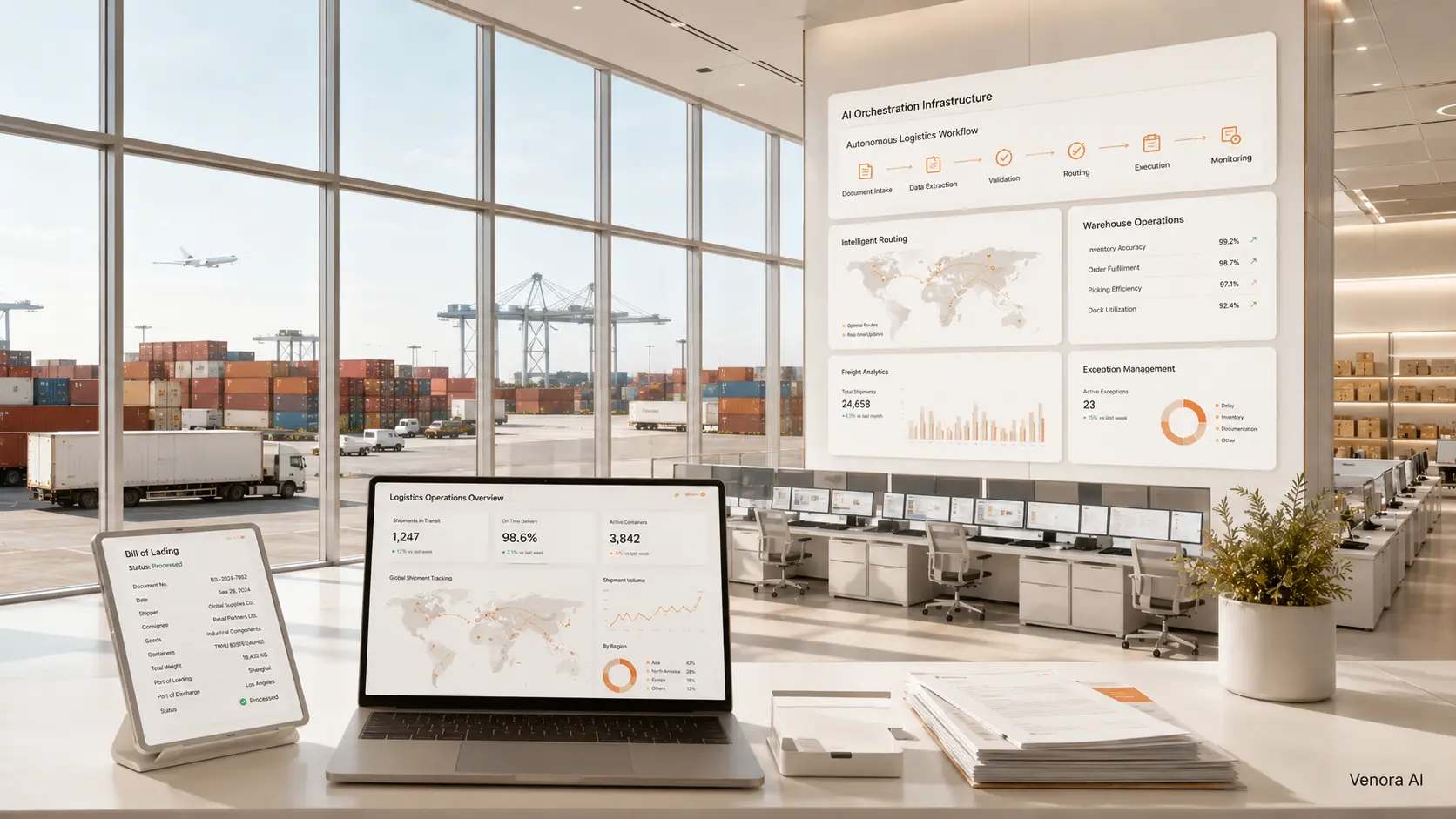
Enterprise Autonomous Multi-Agent AI Infrastructure for Logistics Operations
Global logistics and supply chain organisations manage thousands of operational documents every day, including invoices, customs declarations, bills of lading, warehouse manifests, shipping instructions, compliance records, and delivery documentation. These documents are essential to maintaining uninterrupted logistics operations, yet processing them manually often creates operational bottlenecks that delay shipment releases, increase administrative overhead, and introduce opportunities for human error. As shipment volumes continue to grow, organisations require scalable automation systems capable of processing high volumes of business-critical information while maintaining accuracy, compliance, and operational visibility.
To address these challenges, Venora AI built an Enterprise Autonomous Multi-Agent AI Infrastructure that automates document-intensive logistics workflows through a coordinated network of specialised AI agents. Rather than relying on a single AI model or isolated automation scripts, the platform orchestrates multiple autonomous agents using LangGraph, enabling each agent to perform a dedicated operational responsibility such as document classification, intelligent data extraction, validation, business rule enforcement, anomaly detection, workflow orchestration, and enterprise system integration. This modular architecture mirrors real-world logistics operations while providing a deterministic, scalable, and maintainable automation framework for complex supply chain processes.
The platform was built using Python, FastAPI, LangGraph, OpenAI, PostgreSQL, Redis, Docker, and enterprise REST APIs to deliver a production-ready, API-first automation platform. Independent AI agents collaborate through a shared workflow state to process logistics documents, validate extracted information, coordinate decision-making, and securely route structured data into downstream business systems. By separating document processing, AI reasoning, workflow orchestration, storage, and enterprise integrations into independent services, the platform improves scalability, observability, fault isolation, and long-term maintainability while providing a flexible foundation for future AI-driven logistics automation.
Rather than replacing logistics professionals, the platform augments operational teams by automating repetitive document processing and workflow coordination while preserving human oversight for business-critical decisions and exception handling. By reducing manual processing effort, improving document accuracy, accelerating shipment workflows, and standardising operational processes across the supply chain, the system enables organisations to increase operational efficiency, improve compliance, strengthen data quality, and establish a scalable foundation for enterprise AI-powered logistics operations.
Executive Summary
Enterprise logistics organisations process thousands of operational documents every day, including invoices, customs declarations, bills of lading, warehouse manifests, compliance forms, shipping instructions, and delivery documentation. Although these documents are fundamental to supply chain operations, processing them manually often creates operational bottlenecks that delay shipment releases, increase administrative effort, and reduce overall operational efficiency.
To modernise these workflows, Venora AI built an Autonomous Multi-Agent AI Infrastructure that transforms document-heavy logistics operations into an intelligent, AI-driven processing pipeline. Instead of relying on manual validation or a single Large Language Model, the platform coordinates multiple specialised AI agents through LangGraph, allowing each agent to perform a dedicated responsibility including document classification, intelligent data extraction, validation, workflow orchestration, and enterprise system integration. The result is a deterministic, production-ready workflow capable of processing logistics documentation with greater consistency, scalability, and operational transparency.
Built with Python, FastAPI, LangGraph, OpenAI, PostgreSQL, Redis, Docker, and enterprise REST APIs, the platform combines multi-agent orchestration, intelligent document processing, workflow automation, and modern backend engineering into a unified logistics automation solution. The result is a scalable enterprise platform that accelerates document processing, improves operational consistency, strengthens compliance, reduces manual effort, and provides organisations with a reusable foundation for AI-powered supply chain automation and intelligent logistics operations.
Business Context
Modern logistics operations generate enormous volumes of structured and unstructured documentation.
Every shipment may involve multiple business documents produced by different organisations, suppliers, carriers, customs authorities, and warehouse partners. Although these documents are digital, the business processes surrounding them often remain heavily dependent on manual review.
Operations teams are typically responsible for:
- Validating invoices
- Reviewing customs declarations
- Comparing shipment records
- Checking compliance documentation
- Updating ERP systems
- Confirming warehouse information
- Approving shipment releases
As shipment volumes increase, these manual activities become increasingly difficult to scale.
Hiring additional staff may temporarily increase capacity, but it also raises operational costs and introduces greater variation in document processing quality.
Traditional automation tools perform well when document formats remain consistent. In enterprise logistics, however, documents frequently vary between suppliers, countries, languages, and regulatory requirements.
Venora AI approached this challenge by designing an AI architecture capable of understanding business documents rather than simply recognising templates.
Instead of automating individual tasks, the objective was to automate the complete document processing workflow through coordinated AI agents.
Business Challenge
The organisation had already digitised its logistics documentation, but document processing still depended heavily on manual review and cross-department collaboration.
The primary challenge was not document storage—it was intelligent decision-making.
Several operational constraints influenced the solution architecture.
Manual Document Validation
Every logistics partner generated documentation using different layouts, terminology, and formatting conventions.
Invoices, shipping manifests, customs declarations, and warehouse records rarely followed a consistent structure.
Employees manually compared information across multiple documents before approving shipments, creating a repetitive and time-intensive workflow.
Processing Delays
Document validation represented one of the largest operational bottlenecks within the shipment lifecycle.
Processing frequently exceeded 12 hours, delaying shipment releases and affecting downstream warehouse and transportation activities.
As shipment volumes increased, maintaining service levels became increasingly difficult without expanding operational teams.
Limited Operational Scalability
Seasonal demand spikes required additional staffing simply to process document volumes.
Although increasing headcount temporarily improved capacity, it also increased operational costs, training requirements, and the likelihood of inconsistent document handling.
The organisation required an automation strategy capable of scaling with business growth rather than workforce size.
Data Accuracy and Compliance
Manual processing introduced common issues such as:
- Missing invoice values
- Duplicate shipment records
- Incorrect customs information
- Compliance inconsistencies
- Manual data entry errors
Because logistics documentation directly affects shipment approvals and regulatory compliance, maintaining high data accuracy was essential.
Enterprise Integration Requirements
The solution also needed to integrate seamlessly with existing operational systems.
Rather than introducing another isolated application, the AI platform needed to exchange validated information with ERP platforms, warehouse management systems, CRM applications, and operational dashboards.
This requirement influenced the decision to adopt an API-first, modular architecture.
Solution Overview
To address these challenges, Venora AI built an Autonomous Multi-Agent AI Infrastructure designed specifically for enterprise logistics operations.
Instead of relying on a single AI prompt or rule-based automation engine, the platform orchestrates multiple specialised AI agents using LangGraph.
Each AI agent performs a dedicated responsibility within the workflow while sharing validated information through a deterministic orchestration layer.
The solution combines several core capabilities:
Intelligent Document Validation
Incoming logistics documents are validated, classified, cleaned, and normalised before downstream processing begins.
This ensures consistent handling of documentation originating from different suppliers and logistics partners.
Specialised Information Extraction
Instead of asking one AI model to extract every field, specialised AI agents independently analyse financial, logistics, and compliance information.
Dividing responsibilities enables more structured processing while simplifying maintenance and future expansion.
Consensus-Based Verification
Extracted information is evaluated using a confidence-based verification process.
When predefined confidence thresholds are satisfied, the workflow proceeds automatically.
Cases requiring additional review can be routed to human operators, supporting enterprise governance while maintaining operational efficiency.
Enterprise Workflow Automation
Validated information is automatically distributed to connected business systems, reducing manual data entry and enabling faster operational workflows.
The modular architecture also supports future integration with additional enterprise applications as organisational requirements evolve.
Why Multi-Agent AI Instead of Traditional Automation?
Enterprise document workflows involve multiple business decisions rather than a single processing task.
Attempting to solve every challenge using one AI prompt quickly becomes difficult to maintain, troubleshoot, and scale.
Venora AI selected a Multi-Agent AI architecture because it separates complex workflows into specialised responsibilities.
| Traditional Automation | Multi-Agent AI Infrastructure |
|---|---|
| Rule-based workflows | Intelligent reasoning at every stage |
| Single processing pipeline | Multiple specialised AI agents |
| Difficult to adapt to new document types | Modular and extensible architecture |
| Limited contextual understanding | AI-powered document interpretation |
| Sequential manual validation | Parallel autonomous processing |
This approach mirrors how experienced operations teams collaborate, with specialists responsible for validation, analysis, compliance, and operational decision-making.
By translating that collaborative workflow into software, the platform achieves greater flexibility while remaining easier to maintain over time.
Architecture Overview
The platform follows a deterministic orchestration model in which each AI agent performs a clearly defined responsibility before passing structured output to the next stage.
Rather than operating as an isolated AI assistant, the system functions as an intelligent production pipeline for enterprise logistics.
Incoming Logistics Documents
             │
             ▼
     Validation Agent
             │
             ▼
  Parallel Extraction Agents
   ├── Financial Agent
   ├── Logistics Agent
   └── Compliance Agent
             │
             ▼
      Consensus Engine
             │
             ▼
 Human Review (if required)
             │
             ▼
 Enterprise Integrations
   ├── ERP
   ├── Warehouse Management
   ├── CRM
   └── Shipment Dashboard
Each stage has a single responsibility, making the workflow easier to understand, test, and extend.
This modular architecture also creates a reusable foundation for future enterprise AI initiatives, allowing additional AI agents, workflow stages, business rules, and system integrations to be introduced without redesigning the overall platform.
Rather than building a point solution for document processing, Venora AI engineered an extensible AI infrastructure capable of supporting the next generation of intelligent logistics operations.
Intelligent Workflow
The Autonomous Multi-Agent AI Infrastructure follows a structured processing pipeline designed to automate enterprise logistics document workflows while maintaining accuracy, traceability, and operational reliability.
Rather than relying on a single AI model to complete every task, the platform coordinates multiple specialised AI agents, each responsible for one stage of the document lifecycle.
This separation of responsibilities improves maintainability, simplifies future enhancements, and enables the platform to scale as operational requirements evolve.
Step 1 — Document Validation
Every incoming document first passes through the Validation Agent.
Before any AI extraction begins, the platform verifies that documents are complete, readable, and suitable for processing.
Core responsibilities include:
- Document classification
- Duplicate detection
- OCR cleanup
- Image enhancement
- File validation
- Format normalisation
This initial validation stage prevents poor-quality documents from affecting downstream AI processing and establishes a consistent foundation for the remainder of the workflow.
Step 2 — Parallel Information Extraction
After validation, documents are distributed to multiple specialised AI agents that operate in parallel.
Each agent focuses on a single business domain rather than attempting to extract every field simultaneously.
Financial Agent
Responsible for extracting financial information such as:
- Invoice values
- Taxes
- Currency
- Payment terms
- Supplier details
Logistics Agent
Responsible for operational shipment information including:
- Shipment identifiers
- Container numbers
- Warehouse locations
- Delivery schedules
- Transport references
Compliance Agent
Responsible for regulatory information including:
- Customs declarations
- Import and export details
- Compliance documentation
- Country-specific regulatory fields
Because these agents execute simultaneously, overall processing time is significantly reduced while maintaining clear separation of responsibilities.
Step 3 — Consensus-Based Decision Engine
Enterprise workflows require more than information extraction—they require confidence in the results.
Instead of accepting the output of a single AI model without verification, the platform evaluates extracted information through a consensus engine.
The consensus engine:
- Compares outputs from specialised agents
- Evaluates confidence thresholds
- Identifies inconsistencies
- Determines whether automatic approval is appropriate
When confidence meets predefined business rules, the workflow continues automatically.
If additional review is required, the document is routed to a human operator, enabling a Human-in-the-Loop process for exceptional cases.
This hybrid approach balances automation with operational oversight.
Step 4 — Enterprise Workflow Automation
Once information has been validated, the platform automatically distributes structured data to connected business systems.
Typical integrations include:
- ERP platforms
- Warehouse Management Systems
- Internal CRM platforms
- Shipment tracking dashboards
- Operational reporting systems
Automating these updates reduces manual data entry and helps maintain consistency across enterprise applications.
Technology Stack
The platform combines modern AI technologies with enterprise software engineering practices to deliver a scalable automation solution.
| Layer | Technology | Purpose |
|---|---|---|
| Programming Language | Python | AI orchestration and backend services |
| Workflow Orchestration | LangGraph | Multi-Agent workflow management |
| Large Language Model | OpenAI o1 | Intelligent reasoning and extraction |
| Backend Framework | FastAPI | High-performance REST APIs |
| Database | PostgreSQL | Structured operational data |
| Caching & Queues | Redis | Performance optimisation and task management |
| Deployment | Docker | Portable and consistent deployments |
Every component was selected to address a specific operational requirement rather than simply adopting the latest technology.
The modular architecture allows individual services to evolve independently while maintaining overall system stability.
Security and Governance Considerations
Enterprise logistics operations involve commercially sensitive information, operational records, and regulatory documentation.
The platform was designed with enterprise deployment considerations in mind, supporting security and governance best practices such as:
- Secure API authentication
- Environment-based configuration management
- Protected API credentials
- Containerised deployment
- Separation of AI services from business applications
- Controlled workflow orchestration
- Human review for exceptional scenarios
- Audit-friendly processing architecture
Because AI outputs influence operational workflows, maintaining transparency and predictable behaviour is essential for enterprise adoption.
The deterministic workflow helps organisations understand how decisions are made while allowing human oversight where required.
Scalability and Future Enhancements
The solution was engineered as an extensible AI platform rather than a fixed automation tool.
Its modular architecture enables organisations to introduce new capabilities without redesigning the existing workflow.
Potential future enhancements include:
- Additional specialised AI agents
- Enterprise authentication
- Role-Based Access Control (RBAC)
- Multi-tenant deployments
- Cloud-native infrastructure
- Background processing services
- Managed vector databases
- Enterprise event-driven workflows
- Analytics dashboards
- Predictive operational insights
Because workflow orchestration is separated from business logic, organisations can continue expanding AI capabilities as operational requirements evolve.
Business Impact
The Autonomous Multi-Agent AI Infrastructure transforms document-intensive logistics workflows into an intelligent operational process capable of supporting enterprise growth.
Instead of depending on manual validation across multiple departments, organisations gain an AI-powered workflow that processes documents consistently, integrates with existing business systems, and supports high-volume operations.
Lower Operational Costs
Automating repetitive validation and document processing reduces manual operational effort while allowing teams to focus on higher-value activities.
Faster Shipment Processing
Parallel AI execution significantly shortens document processing times, helping reduce operational bottlenecks and enabling faster shipment approvals.
Improved Data Quality
Specialised AI agents and confidence-based validation improve consistency across financial, logistics, and compliance data before information reaches downstream systems.
Greater Operational Scalability
The platform enables organisations to handle increasing document volumes without redesigning operational workflows, providing a stronger foundation for long-term growth.
Enterprise AI Foundation
Although developed for logistics document processing, the architecture can support a broad range of enterprise automation initiatives, including:
- Invoice processing
- Procurement automation
- Compliance verification
- Insurance claims processing
- Manufacturing documentation
- Healthcare administration
- Financial operations
- Intelligent document processing
Rather than solving a single operational problem, the platform establishes reusable AI infrastructure for future automation projects.
Why This Architecture Works
The platform succeeds because it combines deterministic workflow orchestration with specialised AI reasoning instead of relying on a single, monolithic AI prompt.
| Traditional Document Processing | Autonomous Multi-Agent AI Infrastructure |
|---|---|
| Manual document review | AI-assisted document validation |
| Sequential processing | Parallel specialised AI agents |
| Manual system updates | Automated enterprise integrations |
| Rule-based workflows | AI-powered contextual reasoning |
| Difficult to scale | Modular and extensible architecture |
This architectural approach improves maintainability while allowing organisations to extend automation into additional operational workflows over time.
Frequently Asked Questions
1. What is a Multi-Agent AI system?
A Multi-Agent AI system coordinates multiple specialised AI agents, each responsible for a specific task within a larger workflow. This approach improves maintainability, scalability, and workflow transparency compared with relying on a single AI model.
2. Why use multiple AI agents instead of one model?
Different business tasks require different reasoning capabilities. Specialised agents provide clearer responsibilities, easier debugging, and greater flexibility when workflows become more complex.
3. Can the platform process different logistics document formats?
Yes. The architecture is designed to accommodate documents from multiple suppliers and operational partners, even when layouts and formatting differ.
4. How does the Human-in-the-Loop process work?
When confidence scores fall below predefined thresholds, documents are routed to a human reviewer for validation before continuing through the workflow.
5. Can the platform integrate with existing enterprise software?
Yes. The API-first architecture supports integration with ERP systems, warehouse management platforms, CRM solutions, operational dashboards, and additional business applications.
6. Is the architecture suitable for industries beyond logistics?
Yes. The underlying workflow orchestration model can support intelligent document processing across manufacturing, healthcare, finance, insurance, legal services, and other document-intensive industries.
7. Can additional AI agents be introduced later?
Yes. The modular LangGraph orchestration layer allows organisations to introduce new specialised agents without redesigning the existing workflow.
8. Is the solution suitable for enterprise-scale deployments?
The architecture was designed using modular services, containerised deployment, API-first integration, and scalable backend components, making it well suited for enterprise automation initiatives.
9. Why was LangGraph selected?
LangGraph enables deterministic orchestration between multiple AI agents, allowing each stage of the workflow to maintain shared context while remaining independently maintainable.
10. Can Venora AI build a customised Multi-Agent AI platform?
Yes. Every organisation has unique operational workflows. Venora AI designs and develops bespoke Multi-Agent AI systems tailored to specific business processes, existing infrastructure, and long-term automation goals.
Build an Autonomous Multi-Agent AI System with Venora AI
Enterprise automation requires more than a chatbot.
It requires intelligent systems capable of coordinating specialised AI agents, integrating with business applications, and supporting real operational workflows.
At Venora AI, we design and build enterprise-grade Multi-Agent AI platforms that automate document processing, workflow orchestration, intelligent decision support, and business operations.
Whether you're modernising logistics, streamlining internal processes, or building a custom AI-powered automation platform, our team delivers scalable solutions engineered for long-term business value.
Let's build an AI system that works the way your business operates.
Related Services
- AI Agent Development
- Multi-Agent Systems
- Workflow Automation
- AI Development Services
- API Integrations
Ready to Modernise Enterprise Operations with AI?
Replace repetitive manual workflows with intelligent automation built for enterprise scale.
Talk to Venora AI about designing and building your next Multi-Agent AI solution.