
Bill of Lading Extraction, Rate Confirmations & Track-and-Trace
Deterministic document processing for bills of lading and rate cons, automated email track-and-trace response agents, and TMS integration pipelines for freight operations.

Understanding the daily realities of Logistics & Freight.
Where operational drag, administrative overhead, and repetitive manual tasks create friction in day-to-day work.
Manual Rate Confirmation (Rate Con) Entry
Brokers receive rate confirmations as scanned PDFs and manually key pickup times, commodity descriptions, and rate line-items into their TMS.
Dispatch bottlenecks, human transcription errors, and delayed load booking.
Multimodal OCR pipeline extracting rate cons into validated JSON with line-item accessorial fee detection.
Overwhelming 'Where is my load?' Track-and-Trace Emails
Operations teams spend 40% of their workday reading and answering repetitive status update emails from shippers.
Distracted dispatchers, slow response times, and shipper dissatisfaction.
Automated email agent parsing load numbers, querying TMS/ELD telemetry, and drafting or dispatching real-time status replies.
Proof of Delivery (POD) & BOL Reconciliation Delays
Drivers upload blurry photos of signed PODs; accounting teams struggle to verify legible signatures before invoicing shippers.
Delayed carrier payments, extended days sales outstanding (DSO), and cash flow friction.
Vision AI document pre-processing with signature presence detection and automated invoice reconciliation.
Systems we engineer for Logistics & Freight.
Practical, deterministic workflows designed to replace manual handoffs with reliable software automation.
Rate Confirmation Ingestion to TMS
Dispatcher reads email attachment, manually re-keys carrier rate and pickup address into McLeod or Tai TMS.
Email webhook passes PDF to multimodal parser, validates total amount against quote record, and posts payload to TMS API.
Track-and-Trace Email Response
Shipper emails asking status; clerk looks up load in tracking portal, types response email manually.
NLP agent identifies reference number from subject/body, retrieves GPS coordinates from TMS, and replies within 60 seconds.
Proof of Delivery Validation
Billing specialist visually verifies driver upload has signed stamp and matches original BOL shipment lines.
Vision pipeline deskews document, verifies signature coordinate bounding box, and triggers automated invoice generation.
Capabilities applied to Logistics & Freight.
The specific software engineering disciplines and integration tools applied to make these systems reliable.
Business Process Automation
TMS integration & document processing pipelines
Automates load creation, document routing, and accounting handoffs.
Custom Software Development
FastAPI microservices & high-throughput message queues
Builds real-time freight tracking and dispatch APIs.
API Integrations
TMS / ELD / Telematics API connectivity
Connects telematics providers (Samsara, Motive) to freight backends.
How a typical workflow operates in practice.
An illustrative sequential walkthrough showing how information moves from initial trigger to completed action.
Operational trigger
Inbound customer inquiry, document upload, or system event arrives in your Logistics & Freight workflow.
Structured information intake
Automated pipeline extracts, classifies, and validates the required data fields.
Business rule validation
Data is checked against operational policies, inventory constraints, or database records.
System action & record update
Verified updates are committed to your CRM, ERP, or internal database tools automatically.
Human escalation pathway
Unusual edge cases or high-value exceptions are routed to human operators with complete context.
Illustrative example:The sequence above describes a standard operational topology. Actual integrations are configured around your company's specific software stack, security boundaries, and staff approval rules.
Our engineering and deployment process.
A disciplined, transparent process with direct founder involvement from initial discovery through production testing.
1. Initial operational discovery
A 30-minute introductory call directly with Yash Chhatbar. We review the operational bottleneck, your current software stack, and what a successful outcome looks like.
2. System architecture & scoping
We document the precise data flow, integration endpoints, exception-handling pathways, and human review boundaries before building begins.
3. Iterative development & testing
We build deterministic software pipelines with automated test suites, testing rigorously against real-world edge cases to guarantee reliability.
4. Monitored deployment & handoff
We roll the system out alongside your team with full observability, error logging, and direct staff support to ensure smooth adoption.
Verified case studies in Logistics & Freight
Real client deployments and technical architectures documented by Venora AI.
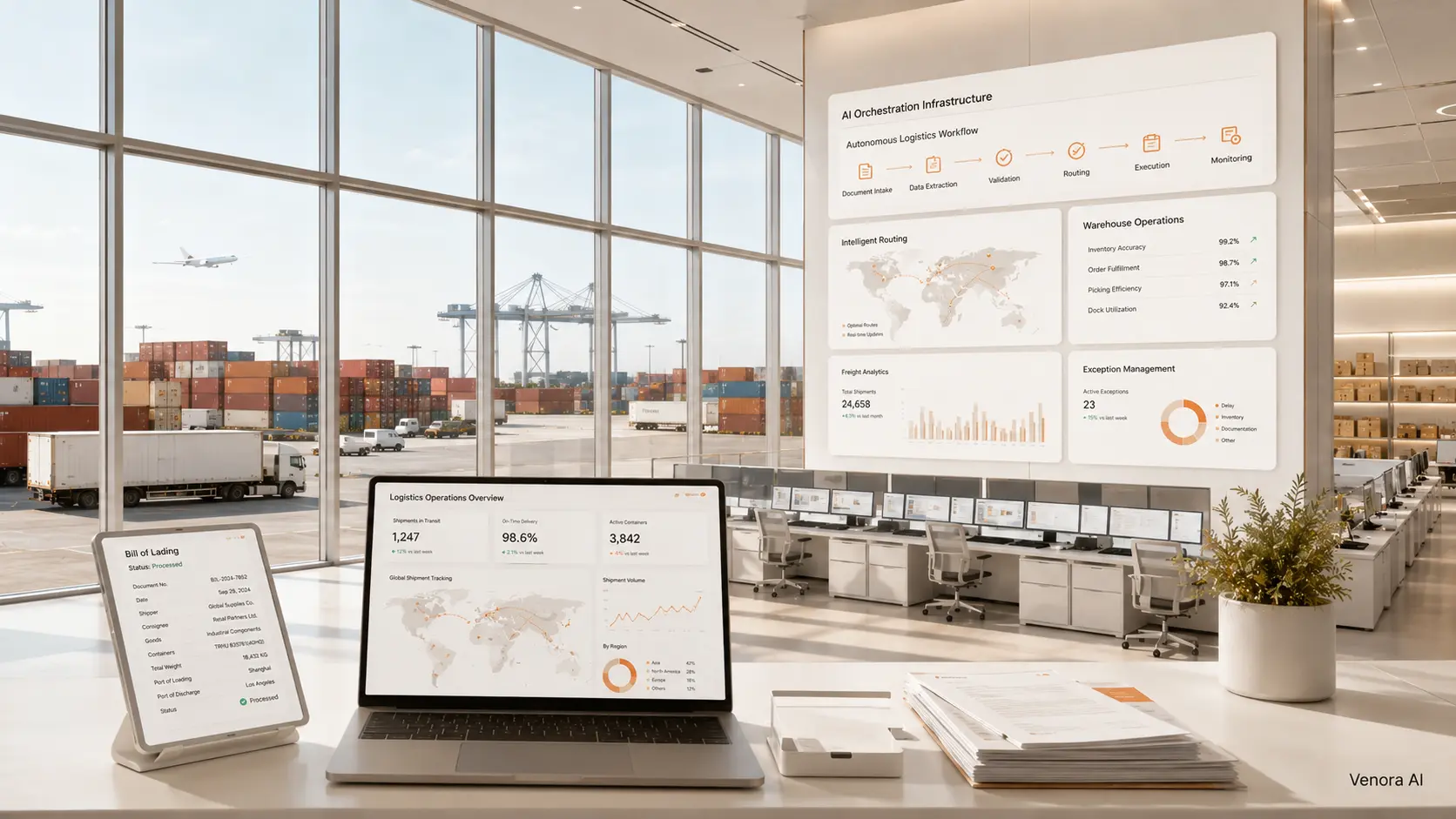
Scaling Logistics Operations with Autonomous Multi-Agent AI Infrastructure
Discover how Venora AI built an enterprise-grade Multi-Agent AI system that automated logistics document processing using LangGraph, FastAPI, OpenAI, and workflow orchestration to improve operational efficiency, increase throughput, and support scalable enterprise operations.

AI Vehicle Number Plate Recognition (ANPR) System for Intelligent CCTV Video Analytics
Discover how Venora AI built an AI-powered Automatic Number Plate Recognition (ANPR) system that combines YOLOv8, OCR, FastAPI, and a modern web dashboard to automate vehicle identification from CCTV footage for security, parking, and logistics operations.
Engineering insights for Logistics & Freight
Technical guides and architectural principles directly relevant to this industry.
How AI Agents Automate Business Workflows End-to-End: Complete Systems Guide for Scalable Operations (2026)
Learn how AI agents automate end-to-end business workflows, reduce manual work, and create scalable systems across sales, operations, and support.
Business Process Automation: A Practical Framework (Not Hype)
A practical framework for deciding what to automate, designing reliable business processes, handling exceptions, and deploying business process automation without unnecessary AI hype.
Common questions about Logistics & Freight systems.
Practical details regarding data privacy, software integration, and system boundaries.
How do you handle crumpled, handwritten, or low-resolution driver photos?
Our preprocessing pipeline applies automated contrast normalization, deskewing, and perspective correction. If critical fields remain below our 0.95 confidence threshold, the file is automatically routed to an exception UI with highlighted bounding boxes.
Can the system ingest rate confirmations sent in email bodies rather than attachments?
Yes. Our email parsing agents evaluate both attached PDFs/images and inline body text, extracting standardized load payloads regardless of format.
Does this require replacing our existing Transportation Management System (TMS)?
No. Our systems are engineered as non-disruptive integration layers that connect directly into your existing TMS (McLeod, Tai, TMW, Rose Rocket) via REST APIs or webhooks.
Looking to automate shipping document parsing and tracking?
Schedule an introductory 30-minute consultation directly with Yash Chhatbar, founder and principal engineer. We will review your current workflow, discuss the practical requirements, and outline what an engineered system would look like.